About Dryland Living
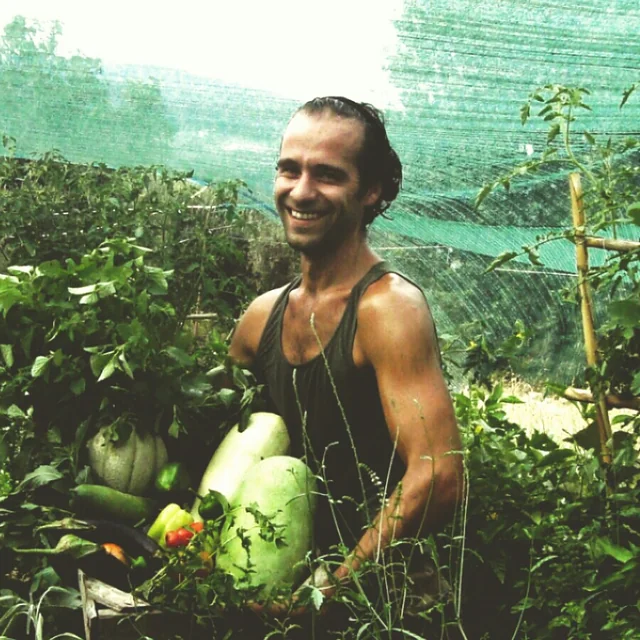
Physidoros Dorieas
Physidoros Dorieas is the writing name of Theodore Vlachogiannis, a smallholder in Dorida, central Greece.
It is a name, not simply a pseudonym. The voice writing here is a composite: my own work on this hillside, the knowledge of the village men who have farmed here for fifty and seventy years, and the study of what has been written about growing in other hot, dry regions. Physidoros is the ordinary smallholder of this place.
I chose to write this way for one reason. Knowledge about growing in a dry climate does not belong to individuals. It is built over generations, in specific soil, by people most of whom never wrote anything down.
The place
Semi-mountainous Dorida, 500 to 650 metres above sea level. Limestone bedrock, clay-loam soil heavy with stone, alkaline pH of roughly 7.6 to 8.1. Rooting depth from 25 to 50 centimetres, depending on the plot.
Rainfall around 750 millimetres, almost all of it between November and March. Three to four months of absolute summer drought. Frosts until mid-April.
One hectare across two non-adjoining plots: olives, vines, open-pollinated vegetables of traditional varieties, aromatics, fruit trees, and an edible food forest on four stremmata that were once scrubland.
Why this site exists
Most of what you read about growing in a dry climate was written by people in temperate regions, adapting advice designed for places where it rains in summer.
Here it does not rain in summer. Not at all.
That difference is not a detail. It invalidates techniques treated elsewhere as fundamental. Permanent living ground cover, direct seeding, leaving weeds alone — all of them assume vegetation that sustains itself. When July has no water, it does not.
The same reasons this advice fails in Phokis are the reasons it fails in California, in Andalusia, in South Australia, and in the Western Cape.
I write what holds up on this hillside: what was tried, what failed, what it cost, and where I still do not know the answer.